
One More for the Ditch: Interview with Eric McLaughlin


I often have the sense that the current state of the world couldn’t possibly get any crazier. Nothing is shocking anymore. There’s nothing left to do but stand back and laugh. Good for us. We’ve reached peak crazy!
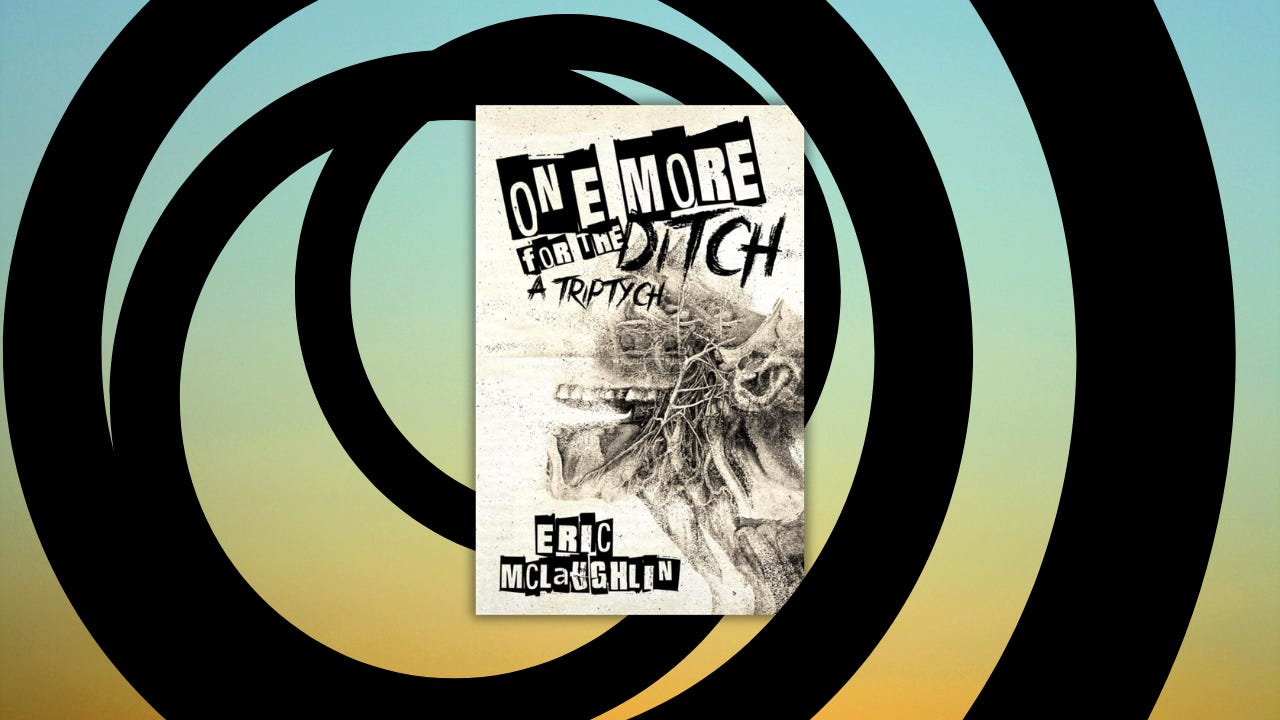
Then I read One More for the Ditch: A Triptych, the new novel by Eric McLaughlin, and I had to admit I was naive to think things couldn’t get crazier. If peak crazy in our current timeline is the moon, Eric takes us past Mars.
That’s not to say that Eric takes the reader anyplace extraterrestrial, or even particularly unexpected. In his novel, we’re here, in America. With corporate corruption in the air and humanoid robots at the doorstep. With imperfect heroes and larger-than-life villains. With the prevailing sense that things couldn’t possibly get any crazier. But of course they can, and do.
I caught up with Eric via email to ask about his new novel, what inspires his writing, and the state of modern literature.
Peter Clarke: The best novels, in my view, are vehicles for unhinged, freewheeling rants. Your new book is full of them. Here’s one of my favorites:
Martin would by CVS and jack up the prices of every over the county fucking sneeze pill and he would buy McDonalds and put rat poison in the Big Macs he would buy industries in every American suburb and pour vitriol in the waters and pay for labs to produce diseases that fed on fat and unleash them at Arby’s and he would buy Hostess Anheuser Busch and put sterilizers in the Twinkies and lead in the Bud Heavies.
Is there a specific rant in this book that you particularly enjoyed writing, or a topic in general that you love to go off on?
Eric McLaughlin: Specifically, no. I am usually one of those guys that can’t look at his own writing after he has written it. As far as topics, very much so. Capitalism especially in its current form. The higher end of social dynamics and the behavior of those in positions of power. I hate to say it, but religion. Not any one specific religion or individual, but religion as it pertains to dogma, as it pertains to the ability of a religion to exploit those who subscribe to it. Really exploitation of all kinds when boiled down.
Your book One More for the Ditch is a triptych, which is a book divided into three distinct sections. What inspired you to write the book in this form?
I wish I could give a better answer to this question, but I just can’t write long. I wish I could. What I would give to have anything longer than 40k words. I might be on a bookshelf one day. But as it stands, I can’t make myself write three paragraphs on genealogy, or describe a waterfall nine different ways. I write what matters as I see it, what needs to be written in the context of a piece, and then I have to move on or it all begins to feel silly in the worst way.
The three stories in One More for the Ditch cover several themes (from the evils of corporate America to the ominous prospect of replacing women with humanoid sex dolls). Can you describe how you see the three stories fitting together?
I see America, or modernity, or life or consciousness, or whatever, in todays terms, as deeply exploitative. I see powerful men taking from the less powerful to give to themselves. I see men and women, friends and family, to have to give up their slice of the American dream because they have been priced out of it. No one I know uses the degree for which they graduated and are drowning from loans they do not benefit from. The three stories are screams into the void, I think. They are the things no one is talking about, or everyone is talking about, but maybe in a way no one is talking about them. At least in fiction. Angry and honest. Without influencer bullshit or political jargon or virtue signaling or any dressing up. Ugly.
If you were to turn this book into a movie, who would you want to direct it?
I don’t know that you could or should. But if it did, someone young and hungry and angry. Someone who wouldn’t add obligatory tits because it sells. Someone who would see the blood in the water and swim for it rather than away from it.
What writers have inspired you most?
As an adult, I idolize the three C’s. Carver, Coetzee, and Camus. You want moral realism? You want unvarnished philosophy? Brutal honesty? Start there. I like to read widely when I can though. King gets a bad rap as a horror writer but The Shining and Pet Cemetery put most modern writers to shame for psychological and relational complexity. Vonnegut never gets enough love. And I love the low calorie stuff as much as the next guy. Sanderson and Abercrombie and Weeks and Butcher and the rest of the fantasy crowd.
What’s one book—perhaps by an unknown author or published by a small press—that no one has heard of and you think more people should read?
People have definitely heard of it, maybe not in the American mainstream, but Disgrace by Coetzee changed the way I see fiction and prose and all of it. Knocked me on my candy ass. I also took a little writing class maybe a decade ago with a now defunct lit mag and I got to read some great shorts. When I Wear Alligator Blood by Marcela Haddad is great. Look it up. I’ve been reading for Fractured Lit a little bit and I tried to push a story through about a dog that made me tear up like a baby. You never know. Good shit is just good.
With the rise of AI chatbots and the decline of fiction readers, I get the depressing sense that long-form fiction writing has become passée or even irrelevant, even though I personally still love to read and write fiction. In your view, is there still a future for the Great American Novel?
Honestly, I don’t know man. I mean, Arthur Miller literally changed the world with Death of a Salesman, and now theatre is as niche as it gets. I think even before AI and chatbots, worldwide instantaneous dissemination of art destroyed the impact of any one piece of anything to change the world. When our fathers were young everyone in America knew the words to “Revolution” and “Help.” Now a band is living the high life with a few thousand listens. Artists with a billion downloads don’t change the way we listen to music. I think there will always be room for good art. For shit that moves you and makes you see things in colors you didn’t even know existed. I find it hard to believe a robot can reproduce that weird spontaneous thing that happens when you read a thing and it just kills you. There may not be a lot of room. Maybe never again. But some. Not enough. But some.
One More for the Ditch: A Triptych is available now from Anxiety Press.
Peter Clarke is the editor-in-chief of Jokes Review. Read his Substack newsletter The Decadence Project and follow him on Twitter @heypeterclarke.
 | A guest post by
|